Our Green Pledge
This website is the smallest example of the rules we build by. You can see those rules in action — measured and printed below, not claimed and hidden.
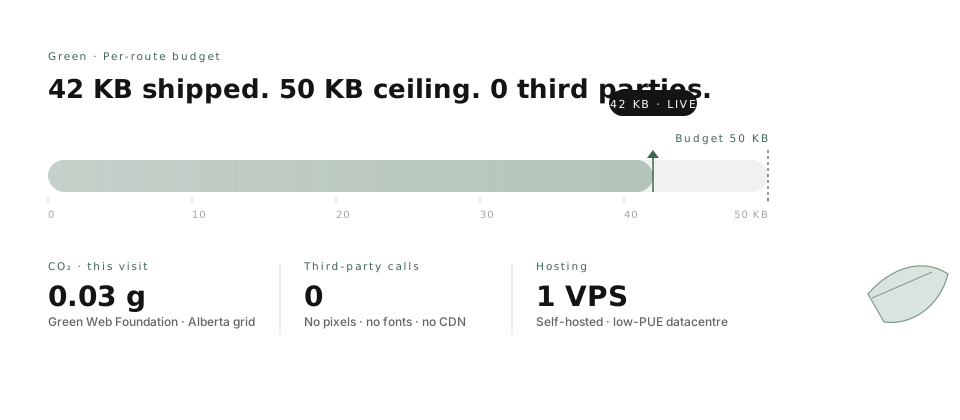
How the byte budget stays small
≤ 50 KB / route
Gzipped. Enforced by CI on every pull request — a build that breaks the budget cannot ship.
Zero
No analytics, fonts, pixels, video embeds, social widgets, or CDN round-trips on this site. Audited per build by no-third-party.mjs.
Server-first HTML
Pages render on the server and stream to the browser. Hydration is opt-in, per-component, never global.
System fonts · SVG
No raster heroes. Inline SVG illustrations. Per-script font subsets loaded only when that script is on the page.
PWA · Service worker
Network-first HTML · stale-while-revalidate assets · offline fallback page on every locale.
Honoured everywhere
Every animation pauses when prefers-reduced-motion is set. No exceptions, no opt-outs needed.
Across the platform
Invoices, medical records, receipts default to digital. Office paper, business cards, and printed marketing collateral are not part of how we operate.
A small website is a climate promise
Every page on this site weighs less than fifty kilobytes on first paint, gzipped. That is roughly the size of a single colour photo. We send no third-party trackers, no external fonts, and no outside scripts. The cost of every page visit in grams of carbon dioxide is estimated and shown in the top status bar, honestly, so you can watch us keep the number low.
A small website is a kind of climate promise. It runs faster on an older phone. It reaches farther on a slow connection. It costs less to power, on our side and on yours. We treat that as the first line of our environmental work, not an afterthought.
What we measure
We measure four numbers and we publish them: the gzipped first-paint size of every route (capped at fifty kilobytes), the number of third-party calls per route (zero), the estimated grams of carbon dioxide per page visit (shown in the status bar), and the proportion of our hosting that runs on certified green energy. The first two are enforced in our continuous integration pipeline — a build that breaks any of them will not ship. The remaining two are reported transparently on the status page.
Numbers without ceilings drift. Ours have ceilings, written into the code. A pull request that would push any route over the budget is rejected automatically, with a precise message about which route grew and by how many kilobytes. The discipline is unromantic. It is also the reason this site loads on a five-year-old phone over a 2G connection.
We publish everything. You hold us accountable.
Every number on this page is computed live from real measurements. The bundle budget is enforced by CI; the third-party count is audited on every build; the carbon estimate uses Green Web Foundation methodology against the page weight you actually loaded. If something looks wrong, tell us — we will respond in writing within five business days, with the underlying numbers shown.